Foreword: Every Time Is the First Time
Every time is the first time.
Every movie I have made is like a fever dream in my mind, as I begin to pursue or answer the call of a new project. The previous films, the ones that nearly killed me, the ones that did kill parts of me, they dissolve into abstraction. I know they happened. I have the scars, the footage, the festival laurels pinned to a wall somewhere. But when a new story starts pulling at me, none of that matters. The body has no memory it is willing to share. The legs don't remember how to walk this road. The hands forget they have held a camera before.
Every time my body has failed me, it's as if I have never taken steps on these legs before. Every time I finish a project, my MS relapses. These are not metaphors. They are the terms of the deal I did not agree to but am bound by nonetheless. Multiple Sclerosis does not negotiate. It does not care about art, or deadlines, or the fact that you have finally found the right piece of music for the opening credits. It comes when it comes, and it takes what it wants.
Who would want to make a movie under these conditions? Who would want to make a movie when the stakes are this high?
I have asked myself this question more times than I can count. I have asked it in hospital beds and in editing suites. I have asked it at three in the morning, staring at a ceiling, feeling the tingling in my hands that means something new is happening, something I will not be able to undo. I have asked it while filling out grant applications with fingers that don't always do what I tell them to do.
The answer is always the same.
Because there is no other way.
My overwhelming desire to tell cinematic stories is the only way I can keep pace with my body's relentless and ever increasing demands upon me. That sentence might sound like bravado, or worse, like martyrdom. It is neither. It is arithmetic. MS takes. Filmmaking gives. The equation is not balanced, it never has been, but it is the only equation I have.
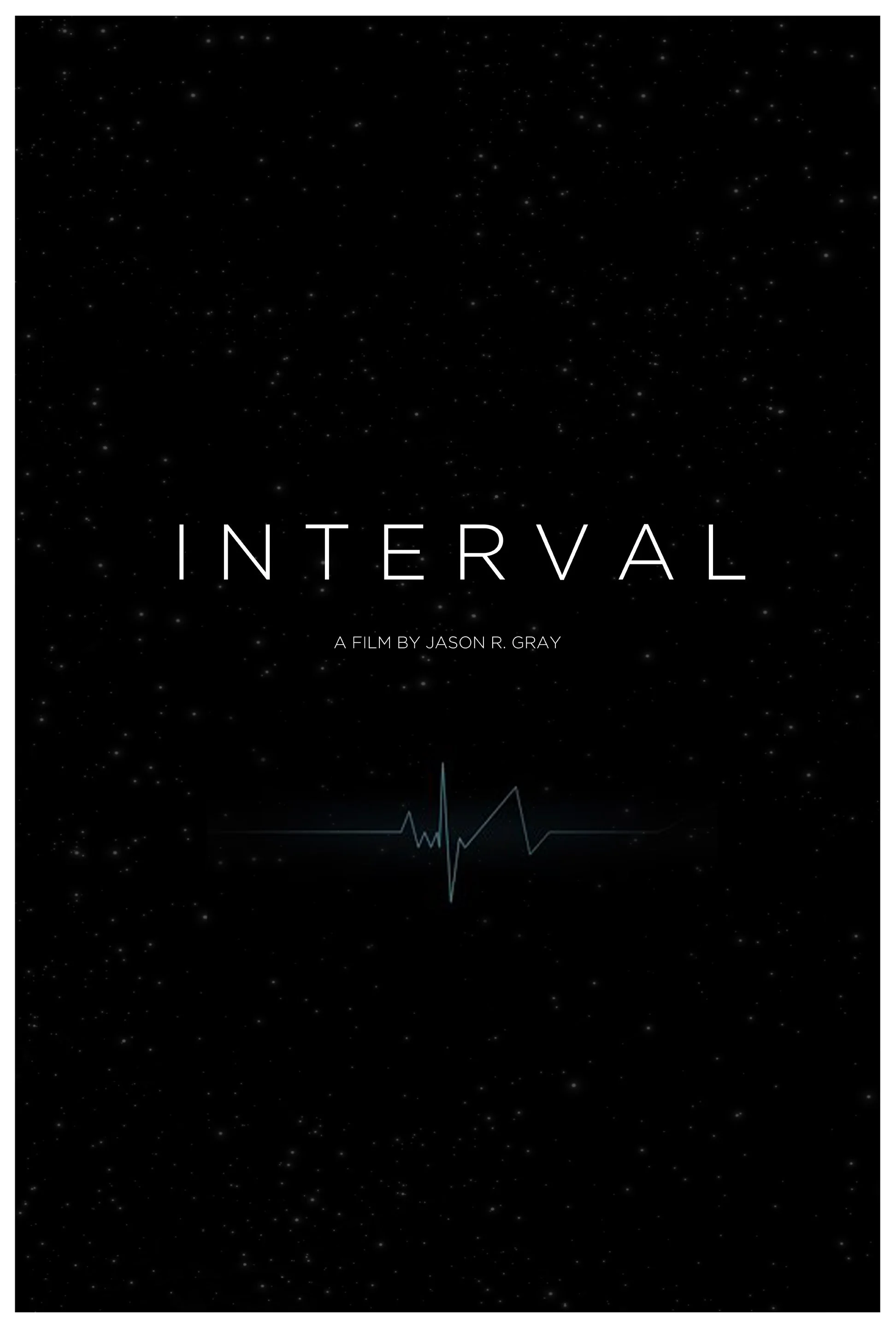
ORIGINAL POSTER CONCEPT (Created in 2016)
I want to tell you about a film called INTERVAL.
I want to tell you about making it, which is to say I want to tell you about living through it, because for me those two things have never been separable. The making of a film is not something that happens alongside my life. It is my life, compressed and distilled and projected outward. And this particular film, this story that has lived inside me for longer than I care to admit, has demanded more of me than anything I have attempted before.
This blog, this series you are reading now, is my attempt to document that process from the inside. Not a polished behind-the-scenes featurette. Not a press kit. The real thing. The ugly, beautiful, terrifying, exhilarating real thing. The days when the work flows and the days when the body says no. The creative breakthroughs and the insurance paperwork. The casting sessions and the neurology appointments. All of it.
Because I have learned, slowly and painfully, that you cannot separate the art from the body that makes it. And my body has a lot to say.
Let me tell you where I am right now, as I write this.
I am looking through the script and listening to the music that I have chosen to play over the opening credits. It is an otherwise normal day, except that nothing about this feels normal. All the promise, mystery and possibility, unfurling from the opening moments of a film that does not yet exist anywhere outside of my head and a stack of pages. The music plays, and I can see it. I can see the film. Not all of it, not clearly, but enough. Shapes in fog. Figures moving through light.
Vision. If I had to lose all of my senses but one, this would be the one I would want to keep most. This is also the one that MS came for first.
I should tell you about that, because it is where this story really begins, years before I ever wrote a word of this screenplay. I woke up one morning and the world had gone wrong. Not dark, not blind, but wrong. Colors shifted. Edges blurred. My left eye decided, without consulting me, that it was going to see the world differently than my right. Optic neuritis, they called it. Inflammation of the optic nerve. A classic early symptom of MS, though I did not know that yet. I only knew that the world I saw through my left eye and the world I saw through my right had become two different places, and I was stranded somewhere in between.
For a filmmaker, a person who has built his entire creative life around the act of seeing, this was not just a medical event. It was an existential one. What do you do when the instrument you depend on most begins to betray you? What do you do when the thing that makes you who you are starts to dissolve at the edges?
You adapt. Or you don't. Those are the options.
I adapted. I learned to work within new parameters. I learned that vision is not just what the eyes do; it is what the mind does with what the eyes provide. And sometimes what the mind provides is better than what the eyes can manage on their own. I learned to trust a different kind of seeing. Not better, not worse, but different. A seeing that accounts for loss. A seeing that has been broken and rebuilt and is, in some ways I am still discovering, stronger for the breaking.
That is what INTERVAL is about, though not literally. It is not a film about a man with MS. It is a film about time, and what happens in the spaces between the moments we think matter most. But it was written by a man with MS, and directed by one, and every frame of it will carry that fact whether the audience knows it or not.
I should also tell you about the word itself. INTERVAL
It means a space between things. A pause. A gap. In music, it is the distance between two notes. In medicine, it is the time between episodes, between relapses, between the last time your body betrayed you and the next time it will. I have lived my creative life in intervals. The space between diagnosis and the decision to keep making films. The space between one relapse and the cautious return to something resembling normal. The space between finishing one project and finding the courage to start another, knowing full well what starting will eventually cost.
Every filmmaker I know talks about the space between projects as a kind of death. The film is done, the crew disperses, the edit is locked, and suddenly you are just a person again, standing in your kitchen, wondering what to do with your hands. For me, that space is literal. The project ends, and the body collapses. Not metaphorically. The immune system, held at bay by adrenaline and sheer will for however many weeks or months the production demanded, finally presents its invoice. And the invoice is always more than I can afford.
I have been hospitalized after wrapping a film. I have lost the use of my legs after completing a final cut. I have watched my vision go cloudy in the weeks following a premiere, standing in front of an audience that had no idea the person introducing the film could barely see the screen behind him.
And every time, every single time, I have eventually gotten up and started writing again.
Because there is no other way.
I find myself in no hurry to finish this script. That's the thing that surprises me about where I am right now. I'm quite certain how it is going to come together, but something is causing me to hesitate. It's not fear of completion. I'm not even sure if it is fear at all.
There is a hesitation that lives beyond fear, in some quieter territory. It is the hesitation of a person standing at the edge of something vast, not because they are afraid of falling, but because they want to remember what it looked like from up here, before everything changed. Because everything will change. It always does. The script on the page and the film on the screen will be two different animals, connected by blood but not by temperament. Knowing where I want this to go, and where it will ultimately go, are two very different things. Two very disparate things. Worlds apart, and with only me to weave the connecting tissue that will ultimately bring them together.
I have a very different body now than I did when I first began this script. The landscape of my life has changed. Mobility that I once took for granted has become something I negotiate with daily, sometimes hourly. There are devices now, accommodations, a whole infrastructure of adaptation that did not exist in my life when the first words of this screenplay were written. But there is still this story that, for some reason, will not let go of me. Or maybe I will not let go of it. At this point I am not sure there is a difference.
This script has waited for me. Through relapses and remissions, through new diagnoses and adjusted prognoses, through the slow accumulation of limitations that MS deposits like sediment, layer by layer, year by year. The story waited. And now, with a far more life than I've ever had going into a production, every atom in my body is telling me this is the right project and this is the time.
I have learned to listen to my atoms. They have been more reliable than my neurologist.
So here is what I am going to do.
I am going to make this film. I am going to document the making of it, here, in these pages, with as much honesty as I can manage. I am going to write about the creative process and the physical reality and the places where they collide, which is everywhere, always. I am going to write about chasing funding, the surreal dual pursuit of financing an independent film and financing the mobility equipment that will allow me to direct it. I am going to write about casting, and crewing up, and the first day of production, and the middle-of-the-shoot grind, and the moment when someone finally says "that's a wrap" and I begin the familiar countdown to whatever my body has planned next.
I am going to write about all of it because nobody else is going to, and because the story of how a film gets made is always, at some level, the story of what it costs to make it. For most filmmakers, that cost is measured in money, time, and relationships. For me, there is an additional line item, and it is written in lesions on my brain and spine.
But here is the part that matters, the part that keeps me coming back, the part that makes me start writing again even when my hands are shaking: the cost is not the whole story. It is not even the most important part of the story. The most important part is the thing that gets made despite the cost. The film. The work. The thing that will exist in the world long after my body has finished having its say.
INTERVAL will be that thing. I am certain of it the way I am certain of very little else.
Every time is the first time. And this time, I am ready.